What Do You Learn in Esthetician School? Inside the 600 Hours
10 min read
If you read ingredient lists for fun and have opinions about cleansers, you already know skincare from the client’s side of the treatment bed. Esthetician school teaches the other side: what happens inside the skin, how to keep every client safe, and how to carry out each treatment step by step, the way a state examiner expects to see it.
So, what do you learn in esthetician school? In New York, a 600-hour program covers skin science and product chemistry, sanitation and infection control, facials and body treatments, exfoliation, waxing and tweezing, makeup, client consultation, and business skills. Theory and supervised practice run side by side, preparing students to sit for the state’s written and practical exams.
Below, we go through the curriculum area by area, with the hours each subject gets and what the New York Department of State evaluates on the practical exam. For the full licensing path, see our guide on how to become a licensed esthetician in New York.
How the 600 Hours of Esthetician School Are Divided
New York’s esthetics license requires a 600-hour approved course of study and passing a written and a practical exam. The figures below come from the School Catalog of Atelier Esthétique Institute of Esthetics (Volume XXII, published November 13, 2025); other programs may divide their hours differently.
In our 600-Hour Esthetics Program, 40% of the time is theory (240 hours) and 60% is practical skill (360 hours), split into two sections of 300 hours. Grouped by area:
| Area of study | Hours | Where it shows up on the practical exam |
|---|---|---|
| Orientation | 5 | Not tested on the practical |
| Safety, health, and infection control | 26 | Part I, plus a safety task in every part |
| Skin science and product chemistry | 110 | Skin analysis during the facial |
| Facials, facial massage, and equipment | 263 | Part III: Facial (60 minutes) |
| Superfluous hair removal | 60 | Part II: Removal of Superfluous Hair (10 minutes) |
| Makeup, eyebrows, and eyelashes | 70 | Part IV: Make-Up Application and Clean-Up (30 minutes) |
| Body procedures and introduction to advanced esthetics | 24 | Not a separate part |
| Career skills and business practices | 42 | Not tested on the practical |
The written exam is multiple-choice and, according to the Department of State, based on the pre-licensing curriculum, so every row feeds into it. Hours may change in later catalogs.
What the New York Practical Exam Looks Like
The Department of State’s List of Tasks Evaluated is the clearest public picture of what your training has to cover. The practical exam takes approximately two hours, with each procedure performed on a mannequin head you bring, within a set time:
- Preparation of Work Area & Model: 15 minutes, 9 tasks evaluated.
- Removal of Superfluous Hair: 10 minutes, 17 tasks evaluated.
- Facial: 60 minutes, 23 tasks evaluated.
- Make-Up Application and Clean-Up: 20 + 10 minutes, 11 tasks evaluated.
Live models are not allowed, so waxing, tweezing, and extractions are simulated. For scheduling, fees, and ID rules, see our guide to the esthetician license in NY.
Sanitation and Infection Control in Every Class
Infection control is taught early and practiced in every class after that. Our catalog gives 8 hours to safety and health, including New York State’s appearance enhancement law, and 18 to infection control and bacteriology, both in the first section of the course, which students complete before working in the clinic.
On the exam, Part I gives you 15 minutes to:
- Sanitize the treatment bed and worktable with a premixed EPA-approved solution in its original, labeled packaging.
- Attach a labeled bag for disposables to your workstation.
- Bring implements such as tweezers in a covered container marked ‘clean’.
- Sanitize your hands, drape the mannequin, and cover its head with a head drape.
Every later part also includes a safety and infection control task. Practicing these steps in each class turns them into habits.
Waxing and Tweezing: Hair Removal Training
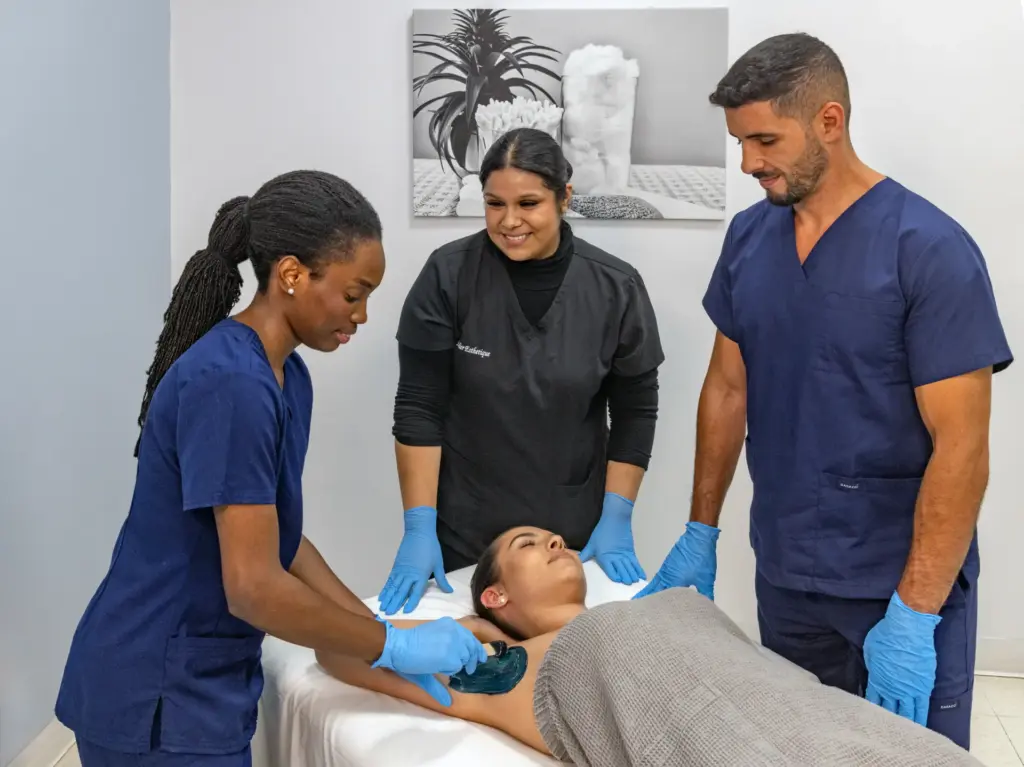
Superfluous hair removal, listed on our program page as waxing and hair removal techniques, gets 60 hours. On the exam, you have 5 minutes for a simulated upper-lip wax with two strips and 5 more for a simulated brow tweeze. The examiner checks details such as:
- Cleansing the upper lip with a mild antiseptic or witch hazel, then powdering it to remove excess oil.
- Testing the wax temperature on the back of your hand or wrist first.
- Applying wax in the direction of hair growth with the spatula at about a 45-degree angle, then pulling the strip the opposite way with the skin held taut.
- Mapping the brow with a tool and tweezing in the direction the hair grows.
Hair removal practice happens under an instructor’s supervision, and the school catalog lists about 60 hours for it.
Skin Science: Learning What You Are Looking At
Skin science is the theory every treatment rests on. Our catalog lists anatomy and physiology (30 hours), the structure and functions of the skin (18), skin diseases and disorders (12), skin analysis (18), and nutrition (5). Together, they teach you to read a client’s skin before you touch it: its type, its condition, and anything that changes how a treatment should be done.
The exam checks this directly. During the facial, candidates analyze the face and neck under a magnifying lamp, with eye pads in place, and gently stretch a small section of skin to check its texture.
Chemistry and Ingredients
This is where a love of skincare products meets the science behind them. Chemistry (6 hours) and chemistry as applied to esthetics (21 hours) cover products, their ingredients, and how to select them, so you learn to match a product to a skin type and a treatment instead of a trend.
Facials, Exfoliation, and Body Treatments
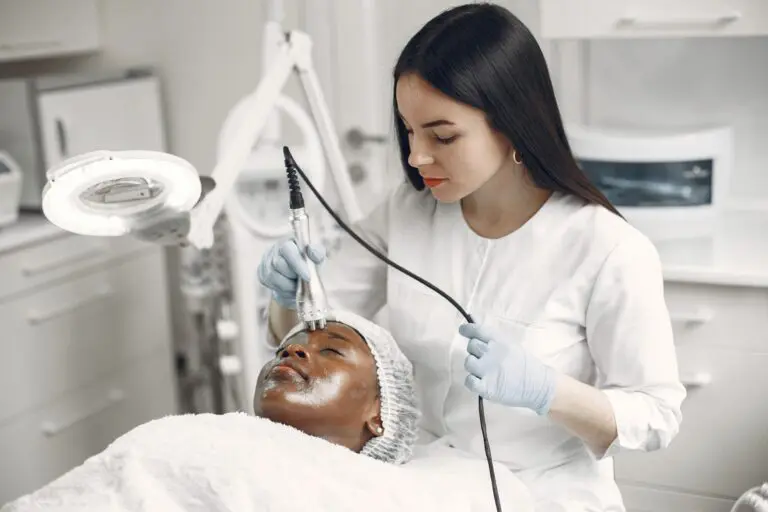
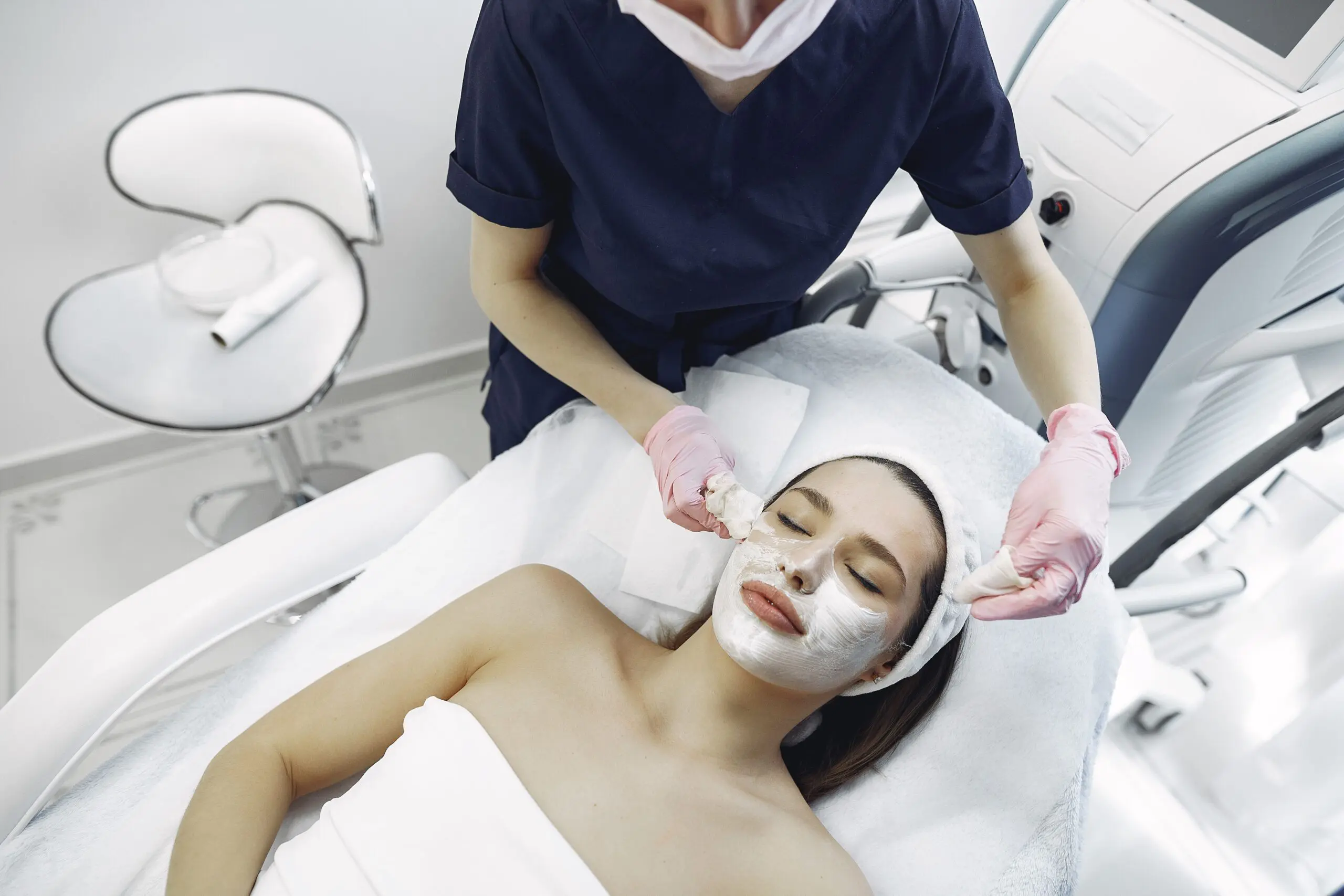
Facials are the largest block: 263 hours across client preparation and the treatment room, basic and full facials, facial massage, and electricity and equipment. Our program page also lists exfoliation and peeling methods as a core treatment, and the chemistry from your theory classes helps you decide which method suits a client’s skin.
The facial is the longest part of the exam, at 60 minutes. Candidates cleanse and tone, analyze the skin, and demonstrate four massage movements: effleurage (light, gliding strokes), petrissage (kneading), friction (deeper rubbing), and tapotement (light tapping). Then come a simulated extraction of comedones, or clogged pores, a treatment mask, and daytime protection.
The program also includes body procedures done without machines (15 hours) and an introduction to advanced, or paramedical, esthetics (9 hours). Neither is a separate part of the exam, but both give you a first look at services beyond the face.
Makeup, Brows, and Lashes
Makeup gets 70 hours: 50 for makeup techniques and 20 for eyebrows and eyelashes. Our program page calls this area makeup artistry and color theory, the part that helps you choose shades for a face, not just apply them.
On the exam, you have 20 minutes for a complete daytime makeup on your mannequin, from foundation matched to its skin tone and blended concealer to at least two eyeshadow shades, pencil eyeliner, hair-like brow strokes, and lined lips. Fingers cannot be used to blend eyeshadow. The last 10 minutes go to clean-up, with used implements in a ‘dirty’ container and the workstation cleaned with an EPA-approved sanitizer.
What You Learn in Esthetician School Beyond the Exam
Not everything you learn is graded by an examiner. Our program page lists client consultation and customized skincare plans, communication and ethics in spa settings, and business skills such as retailing, marketing, and entrepreneurship. In the catalog, career skills get 12 hours and business practices 30, and our FAQ notes that guest lecturers speak with students on employment and business topics.
These are the skills behind a working day: asking the right questions before a treatment, recommending products a client actually needs, keeping returning clients, and planning where you want to work. After graduation, career services support is available as you look for work in salons, spas, and wellness centers.
How Theory and Practice Fit Together
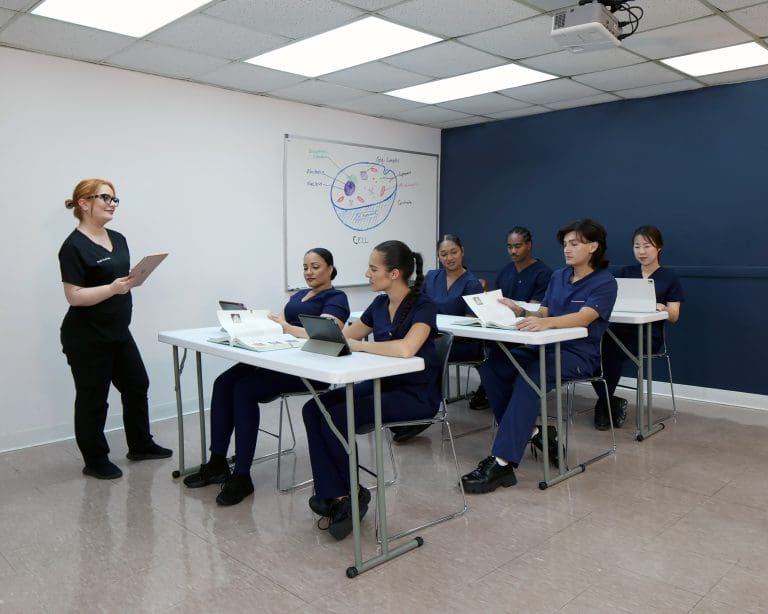
According to our FAQ, every topic has both a theoretical and a practical element, and both begin on the first day. Practical classes have a maximum of 20 students and theory classes a maximum of 30, and senior students focus more heavily on practical applications during the last 300 hours. On the hybrid schedules, theory is taught online and practical skills in person; our article on esthetician school online explains that split.
Practice With Real Clients in the Student Clinic
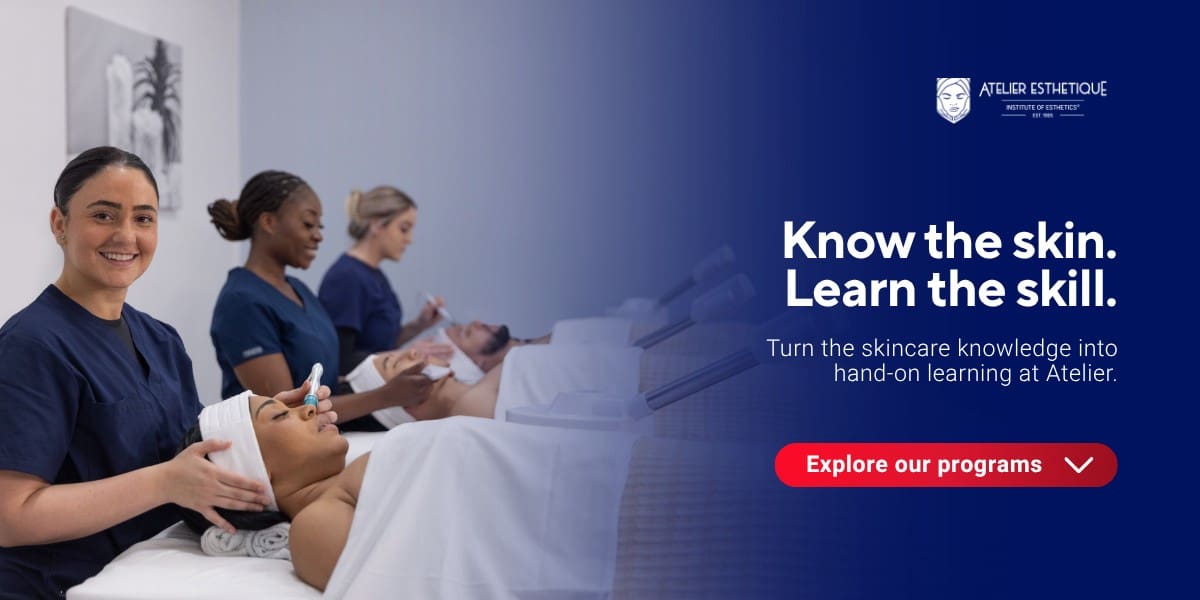
After successfully completing the first section of the course, students can begin performing services in our student clinic, which is open to the public. Services are performed by supervised esthetics students as part of their hands-on training, and Atelier has two on-campus educational spas where practical training happens in a spa setting.
This is what a mannequin cannot teach. In the clinic, you work on real skin, talk a client through a consultation, adjust to what you see, and manage your time with a person on the treatment bed.
See the Curriculum Up Close
A course list only tells you so much. The clearest way to understand what you would study is to watch a practical class and see the student clinic in person. At Atelier, you can visit our esthetician school in Manhattan, sit in on a class, and ask how each subject on this list is taught. When you are ready, Book a Tour.
Thinking about starting your esthetics career?
Book a TourFrequently Asked Questions
Yes. At Atelier, the 600-hour curriculum includes makeup artistry and color theory, and the school catalog lists about 70 hours for makeup. Makeup is also part of New York’s practical exam: according to the Department of State’s list of tasks evaluated, Part IV covers makeup application and cleanup.
More hands-on. In Atelier’s 600-hour program, 60% of the time is practical skill (360 hours) and 40% is theory (240 hours), according to our School Catalog published in November 2025. Each topic combines both from the first day, and senior students focus more heavily on practical applications during the last 300 hours.
Yes, but it is chemistry applied to skincare. Our catalog includes 6 hours of general chemistry and 21 hours of chemistry as applied to esthetics, which covers products, their ingredients, and how to select them. You do not need a science background to start; the goal is to understand how products work on the skin.
Yes. At Atelier, students begin performing services in the student clinic after successfully completing the first section of the course. The clinic is open to the public, and services are performed by supervised esthetics students as part of their hands-on training. The New York practical exam, by contrast, is performed on a mannequin head, not a live model.
It covers the foundations. Our curriculum includes 30 hours of business practices and 12 hours of career skills, with topics such as retailing, marketing, entrepreneurship, and client consultation. Keep in mind that an esthetics license alone does not let you operate a business in New York; according to the Department of State, a separate business license is required.