How Long Does It Take to Become an Esthetician? The Four Phases
10 min read
When you are just starting to think about a career change, the program length on a school’s website tells only part of the story. There is time before your first class, while you decide and apply. There is time after your last class while the state reviews your application and you take two exams. Then come your first months of building a client base.
How long does it take to become an esthetician? The required training hours vary by state, and in New York the requirement is 600 hours. At Atelier Esthétique Institute of Esthetics, you can complete these hours in as little as 16 weeks full-time or 40 weeks part-time. The State’s application and exams come after.
This guide follows the whole path in four phases, from the week you start comparing schools to your first months with a license, and shows which parts run on a fixed clock and which depend on you.
The Four Phases at a Glance
Only one of the four phases has a set minimum. The others depend on your decisions, the State’s processing, or how you build your work once you are licensed.
| Phase | What happens | How long it takes | Who sets the pace |
|---|---|---|---|
| 1. Deciding and applying | Visiting schools, applying, and completing admissions requirements | No fixed length; admissions are rolling | Mostly you |
| 2. Esthetician school | 600 hours of approved training in New York | Can be completed in as little as 16 weeks full-time or as little as 40 weeks part-time | The schedule you choose |
| 3. Exams and license | Application, written exam, and practical exam with the Department of State | The State does not publish processing times | The State, plus how soon you apply |
| 4. First months licensed | Finding a position and building a clientele | Ongoing, with no standard timeline | You, your workplace, and your clients |
Phase 1: Deciding on Esthetics and Choosing a School
This is the phase most timelines leave out and the one that belongs entirely to you. It has no minimum or maximum: it lasts as long as you need to confirm that esthetics is the right license, compare schools, and line up your paperwork. If you are still weighing esthetics against other beauty licenses, our step-by-step path to a New York esthetics license starts with that decision.
The Three Admissions Steps
At Atelier, there is no single yearly deadline to work toward, because the school operates on a rolling admissions basis. Our admissions process has three steps:
- Meet with an admissions representative. You learn about the programs and get a tour of the campus. You can also schedule an appointment to sit in on a current class for an hour.
- Apply. You complete an application for the program and schedule you are interested in. No prior esthetics experience is required, but you need a high school diploma or equivalent to apply.
- Complete the admissions requirements. Your representative helps you gather transcripts and other documents and, if you are seeking aid, schedule a financial planning session.
You are considered enrolled once those requirements are met and you sign an enrollment agreement. An application on its own does not hold a seat in an upcoming class, which is one reason the school encourages applying early.
What Keeps This Phase Moving
Two things usually set the pace here: documents and money. Applying early gives you time to collect transcripts and finish any funding applications before your preferred start date. Financial aid is available for those who qualify for the 600-hour program, and our federal school code for the FAFSA is 041787. Our guide to what esthetician school costs and how to pay for it can help you plan that part.
Once the paperwork is moving, choose a start date for your schedule. Each schedule has its own start dates, listed on the program page, and the one you pick becomes the first fixed date on your timeline.
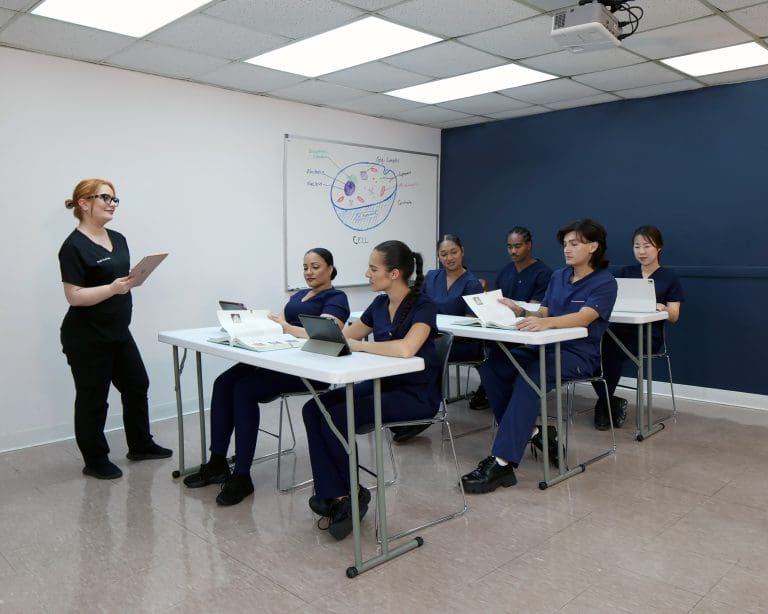
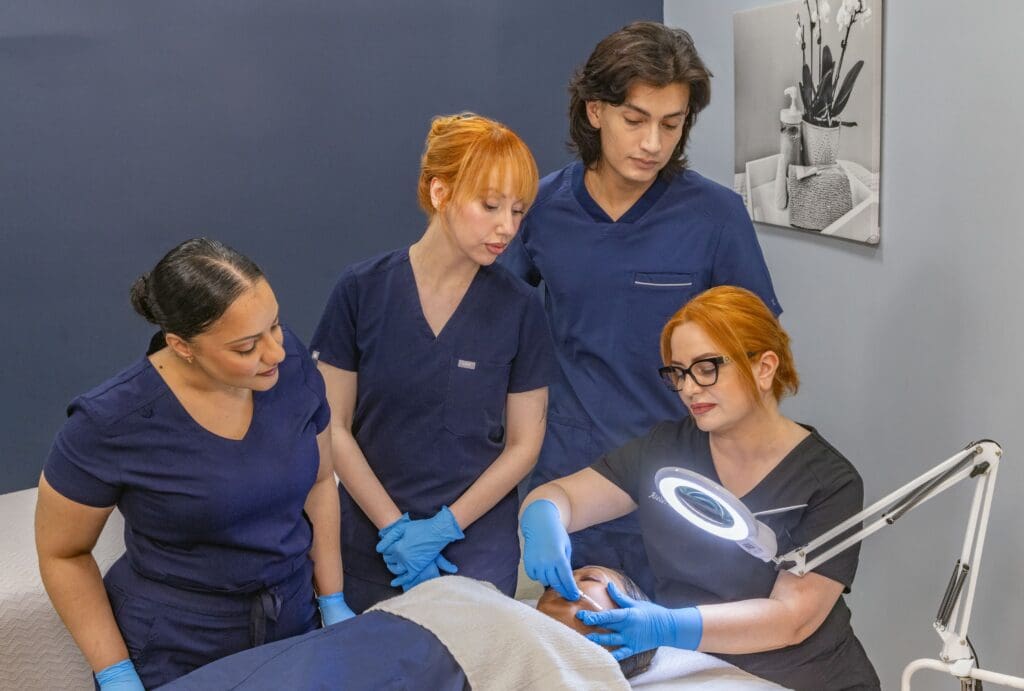
When you visit, pay attention to the people as much as the rooms. The students you see in a practical class are a preview of the classmates you would train beside, and instructors are licensed by the New York State Education Department.
Phase 2: Esthetician School, the Part With a Set Minimum
How many hours is esthetician school? It depends on the state where you plan to work, because each state sets its own rules. The Bureau of Labor Statistics notes that licensing requirements vary by state. In New York, you need a 600-hour approved course of study before you can apply for an esthetics license.
The hours are the same on every schedule; what changes is how many fit into your week. At Atelier, the 600-Hour Esthetics Program runs on three schedules. Full-Time can be completed in as little as 16 weeks. The 3-Day Half-Day and Evening/Weekend Hybrid schedules can each be completed in as little as 40 weeks, and the hybrid format teaches theory online and practical skills in person.
That is the esthetician program length on paper. If you want to see how each schedule fits a weekday job, evening shifts, or a break between jobs, our guide with sample timelines for each schedule walks through them one by one.
How the 600 Hours Unfold
Esthetician school is not a long stretch of lectures followed by practice at the end. At Atelier, theory and hands-on work begin on the first day, and each topic includes both. The curriculum moves through skin science, treatments such as facials, waxing, and makeup, and client care topics like consultation and business skills. During the last 300 hours, senior students focus more heavily on practical applications.
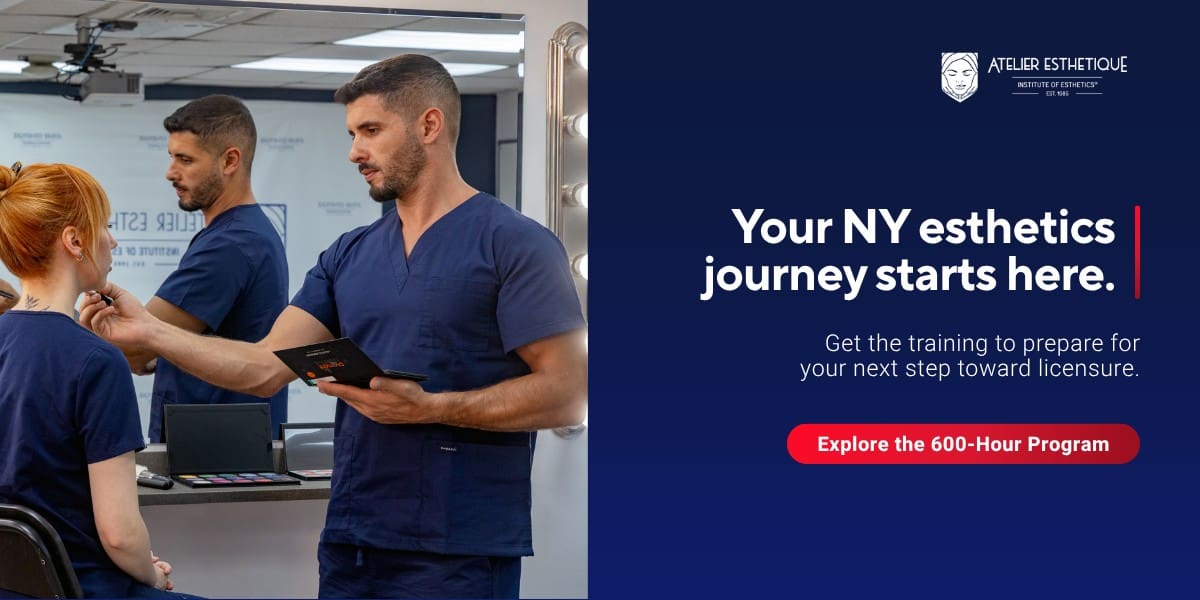
Practical classes have a maximum of 20 students, and theory classes a maximum of 30. You also receive clinical experience in our two on-campus educational spas, with a clinic open to the public and operated by supervised students providing the treatments.
Phase 3: The State Exams and Your License
Finishing school does not make you an esthetician yet. Your school prepares you to sit for the New York State exams; the Department of State gives those exams and issues the license. A certificate from a course is not a license, and no school can issue one on its own.
In short, once your hours are complete, you fulfill the state’s certication requirements. After the department reviews and accepts it, you schedule and pass a written exam and a practical exam. The Department of State lists every requirement on its Become an Esthetician page.
This is the least predictable phase, because the state does not publish how long it takes to review an application or how soon exam dates open up. Our Student and Career Services advisors can help you prepare for this part of the process. Plan a buffer between your last class and the date you hope to start working. For each step in order, and for what you can do to avoid delays, read what happens after your last class.
Phase 4: Your First Months as an Esthetician
The license lets you start working, but building a steady base of clients takes time. It depends on where you work, the services you offer, and how many hours you put into your new career.
Looking for a Position With Support
Licensed estheticians can pursue roles in spas, salons, and skincare settings; in makeup artistry; and in clinical esthetics in medical settings. The Bureau of Labor Statistics describes skincare specialists as usually working in salons and spas, with some self-employed.
At Atelier, career services support students and graduates as they look for work, and guest lecturers talk with students about employment and business topics. We will assist you in finding a position; however, no school can promise you a job, and your own professionalism makes a difference.
Building a Clientele
Whether you join a spa or eventually work for yourself, clients who come back are what fill a schedule. The BLS points to being friendly and courteous as a way to encourage repeat business, and notes that self-employed skincare specialists generate their own business opportunities.
Some of that groundwork starts in school. The Atelier curriculum includes client consultation and customized skincare plans, communication and ethics in spa settings, and business skills such as retailing, marketing, and entrepreneurship. In your first months, a few habits put those skills to work:
- Suggest a next visit at the end of each treatment, based on the skin goals you discussed in the consultation.
- Keep notes on each client’s skin, products, and preferences, so every appointment picks up where the last one ended.
- Explain home care clearly, since product recommendations are part of the service.
- Let satisfied clients know you welcome referrals.
Putting Your Own Timeline Together
To estimate your own path, work through the phases in order. Give yourself the time you need to decide and apply, choose the schedule that fits your week and note its minimum, and add a buffer for the state’s review and your exams. Then treat your first months as a licensed esthetician as part of the plan, not as the finish line.
If you would like to map those phases with someone who knows the process, our esthetician school is in Manhattan, only a 5-minute walk from Penn Station. Book a Tour, sit in on a class, and bring your questions about schedules and start dates.
Thinking about starting your esthetics career?
Book a TourFrequently Asked Questions
Not at Atelier. New York requires 600 hours of approved training, and the Full-Time schedule, which meets Monday to Friday from 9am to 5pm, can be completed in as little as 16 weeks. After training, the license application and the two state exams add their own time, which the Department of State does not publish.
Atelier uses rolling admissions, so there is no single deadline, and each schedule has its own start dates. The school encourages applying early so you have time to gather transcripts and other documents and to complete any funding applications. An application alone does not hold a seat; you are enrolled once the requirements are met and you sign an enrollment agreement.
Each state sets its own licensing rules, including the number of training hours, so aesthetician school length depends on where you plan to work. The Bureau of Labor Statistics notes that licensing requirements vary by state and suggests contacting your state board. In New York, the requirement is a 600-hour approved course of study, followed by a written and a practical exam.
At Atelier, the 900-Hour Master Esthetics Program can be completed in as little as 24 weeks on its full-time schedule. It combines the 600 licensing hours with 300 advanced hours. The New York State license covers the first 600 hours; the additional 300 hours are recognized with school certificates of completion. New York does not issue a separate master esthetician license.
There is no standard timeline. It depends on where you work, the services you offer, how many hours you are available, and whether clients return. Habits that encourage repeat visits, such as thorough consultations, clear home care advice, and suggesting a next appointment, help from your first week. At Atelier, career services support graduates as they look for a position.